Carrie Heitman
"I can not recommend ICS highly enough. Hook & Eye Theater had a wonderful experience working with Shelby and the team at ICS from beginning to end. What an incredible organization serving the theatrical community and beyond."
Areas We Serve · Austin
For days that have more than one organisation running them.


Whose accommodation is it
Count the parties involved in an ordinary Austin evening. A club owns the room; someone else programmed what is happening in it; during a festival week a third organisation put both of them in a schedule and sold the badge. A match day has the club, the operator of the ground, and whoever holds the broadcast. A lecture has the department that arranged it and, separately, whoever holds the budget line that pays for access. A visiting production arrives with its own crew and leaves again on Sunday. Each of those is a real organisation with real staff, and an attendee who needs an interpreter has to guess which of them to write to.
What follows is usually not a refusal. It is a forward. The club sends it to the promoter, the promoter sends it to the festival, the festival sends it back to the venue, and every one of them is being reasonable, because none of them can unilaterally commit a position on the stage, a feed from the desk, or the money. Two weeks go by inside that loop and the answer arrives after the date it was about. Nobody in the chain did anything wrong and the person who asked still could not attend.
The only durable fix is to write down who holds it. So the first thing we ask for is not a running order but a short list of names: who runs the building, who programmed the thing happening in it, who received the request, and who can approve a spend. If several of those sit on one site, the quote covers the site once rather than arriving three times. If you are the party that got the request and cannot pay for it, say so — the scope is written so it can be handed to whoever can, intact, instead of restarting from an empty inbox.

Where we work in Austin
The most useful map of this city is not a geographic one. Downtown is thick with buildings whose evenings are programmed by somebody other than their owner; the campus runs its own rooms under its own rules; the park is public land with private events standing on it; the towns past the city line answer to their own districts. Where your day sits on that map is what decides how many conversations it takes — which is why the organisations involved are the first thing we ask for and the address is the second.
The theatre on Congress, the club rooms and stages a few streets east of it, hotel meeting floors, and the government and court buildings at the top of the avenue.
Neighborhoods we cover
What we provide in Austin
Each of the six below needs something from somebody other than us — a position, a feed, a file, a deadline. The note against each one says which, so you know who to copy in when you reply.
American Sign Language, tactile signing for DeafBlind attendees, and International Sign. The venue is the party to involve early here, because where a provider stands and what lights them is the building's call rather than the promoter's.
Learn more about ASL & Sign Language InterpretingSettings we staff here
Ordered by how many organisations get a say. Near the top there is usually one, and the conversation is short. Near the bottom there are three or four, and until we know which of them you are, any figure we give you is guesswork.

Exhibitions, openings and gallery talks where one institution controls the space, the programme and the catalogue language, so a single conversation settles the whole booking.
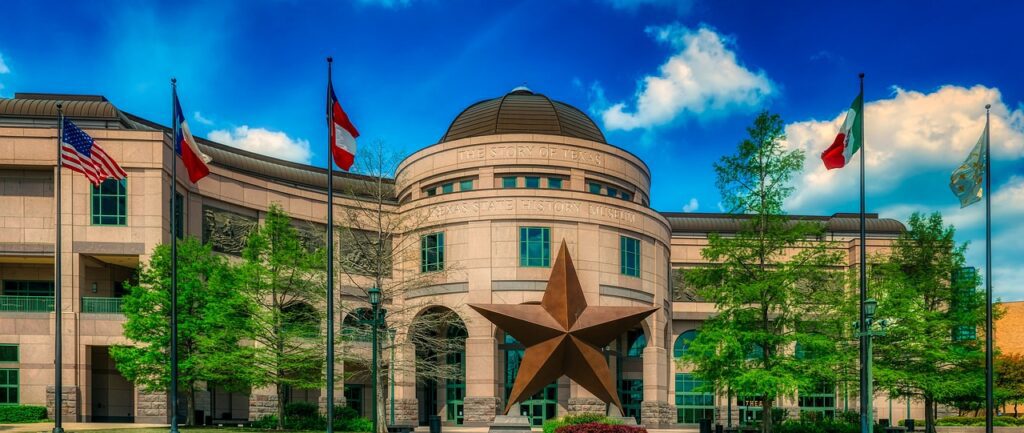
Permanent galleries, school visits and public programmes at collections whose material is state-owned, where what a describer says about an object is checked against the institution's own wording first.
Lectures, labs, orientations and society events, where the department that arranged the room and the office that funds the accommodation are usually two different desks with two different calendars.
Historic houses on and off the avenue taking in shows that move on after a week — the house holds the room and the licence, the production holds the script, and both are needed before anybody prepares.
Rooms of a few hundred people running someone else's line-up most nights of the week, generally with no member of staff whose job access is, and the shortest lead time of anything on this list.
Park events, trail programmes and open-air stages where the parks authority, the event's organiser and whoever brought the sound system each control a different part of what a provider needs.
Football and soccer fixtures where the club, the operator of the ground and the rights-holder divide the bowl between them, and access on the concourse is a different decision from access on the video board.
A week when a single badge covers dozens of buildings that are not owned by the organisation printing the badge — the most parties of anything we staff here, and the one to start earliest.
Where Austin bookings land
Austin programmes outdoors for most of the year and indoors for the rest, and the accommodations change completely between the two. These are the sites the requests keep naming.

Festivals, performances and civic events across an open site. Sign language interpreting and live captioning are staged at the stage, and signage points to where they are — a field has no obvious front row.
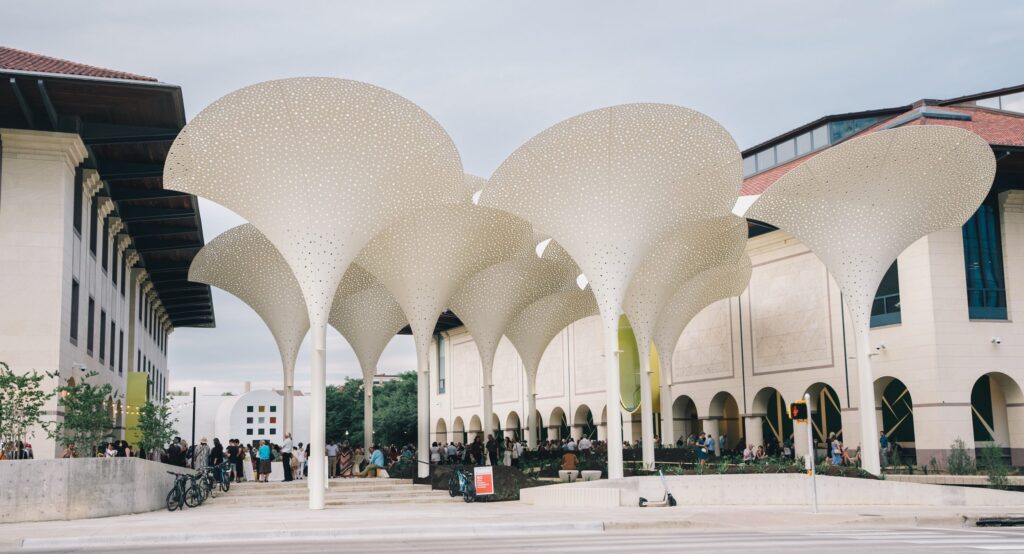
Interpreting, live captioning, audio description and multilingual subtitles together cover the Blanton Museum's exhibitions and its public events.
Audio description carries the exhibits for blind and low-vision visitors; document and media translation opens the written material to visitors arriving in another language.
Congress Avenue's historic house. Multilingual subtitles, audio description and live captioning let non-English-speaking, blind and Deaf patrons share the same performance.
A Longhorns game or an Austin FC match runs the same three accommodations: an interpreter in view of the section, captions on the board, and a coordinator reachable while the match is live.
Working in Austin
Before anything can be priced, four roles need names against them: the building, the programme, the person who received the request, and the person who can approve a spend. That is the whole of the ask, and a booking that stalls in this city has nearly always stalled because one of the four was left blank — at which point each remaining party can quite reasonably assume somebody else is holding it. With them filled in, the work is unremarkable: providers matched to the material, a costed reply on the next working day, and a coordinator who speaks to each of those parties directly instead of leaving you to relay between them.
Client Stories
4.8 · Based on 240 Reviews
Carrie Heitman
"I can not recommend ICS highly enough. Hook & Eye Theater had a wonderful experience working with Shelby and the team at ICS from beginning to end. What an incredible organization serving the theatrical community and beyond."
Frank Starling
"Accessibility is an essential part of inclusion, and Inclusive Communication Services delivered it with excellence at Cannes Lions International Festival of Creativity. Their ASL interpreting, CART captioning, and service coordination teams supported our conference stages, networking spaces, and last-minute changes with calm professionalism and deep care."
Christina Dixon
"I had the pleasure of seeing the ICS American Sign Language interpreting team at a conference in San Francisco. Their professionalism and expertise puts them in a league of their own. Shelby and her team set the standard for professionalism, coordination, and accessibility."
Laura Mosteller
"Our company has been using ICS for years at our annual conference. Their kind and clear communication leading up to the event and their prompt arrival each day makes the choice a no-brainer."
Patrick McMullen
"Inclusive Communication Services did an amazing job at Cannes Lions Festival. They treated us with kindness and made sure we had full access to interpreters the whole time. It honestly felt like everything was normal."
Emily Johnson — AADMD
"We have loved working with ICS and appreciate their flexible approach to working with our budget. The services have been game changing for what we are able to provide."
What to expect
The numbers below are ours. The item at the end of them is yours, and on a shared site it governs the schedule more reliably than any of the other three.
How booking works
Where it is, what it is, and who else is involved — operator, promoter, production, department, whoever it turns out to be. Naming them at this stage is what stops the same request being priced twice from opposite ends.
The reply separates what we supply from what each of those parties has to decide: a position and a light, a feed from the desk, a script or a set of files, a print deadline. Each item says whose it is.
Where several organisations share a day, the price covers it once and is itemised so each party can approve its own portion — or so one of them can take the whole thing on without the scope being rebuilt.
The agreed placements, feeds and contacts go to all parties before the day, and a day-of number reaches the people actually in the building rather than only the person who signed.
Frequently asked questions
Get started
The date, the venue, and every other organisation with a say in it. The reply lands on the next working day: one costed plan covering the whole site, with a line against each item naming which of you has to agree to it.