
Accessibility
VRI vs. On-Site Interpreting: How to Choose
A practical comparison for event planners, coordinators, and access leads weighing Video Remote Interpreting against sending an interpreter in person.
July 10, 2026 · 3 min read
By Shelby Edwards · · 2 min read
Last updated
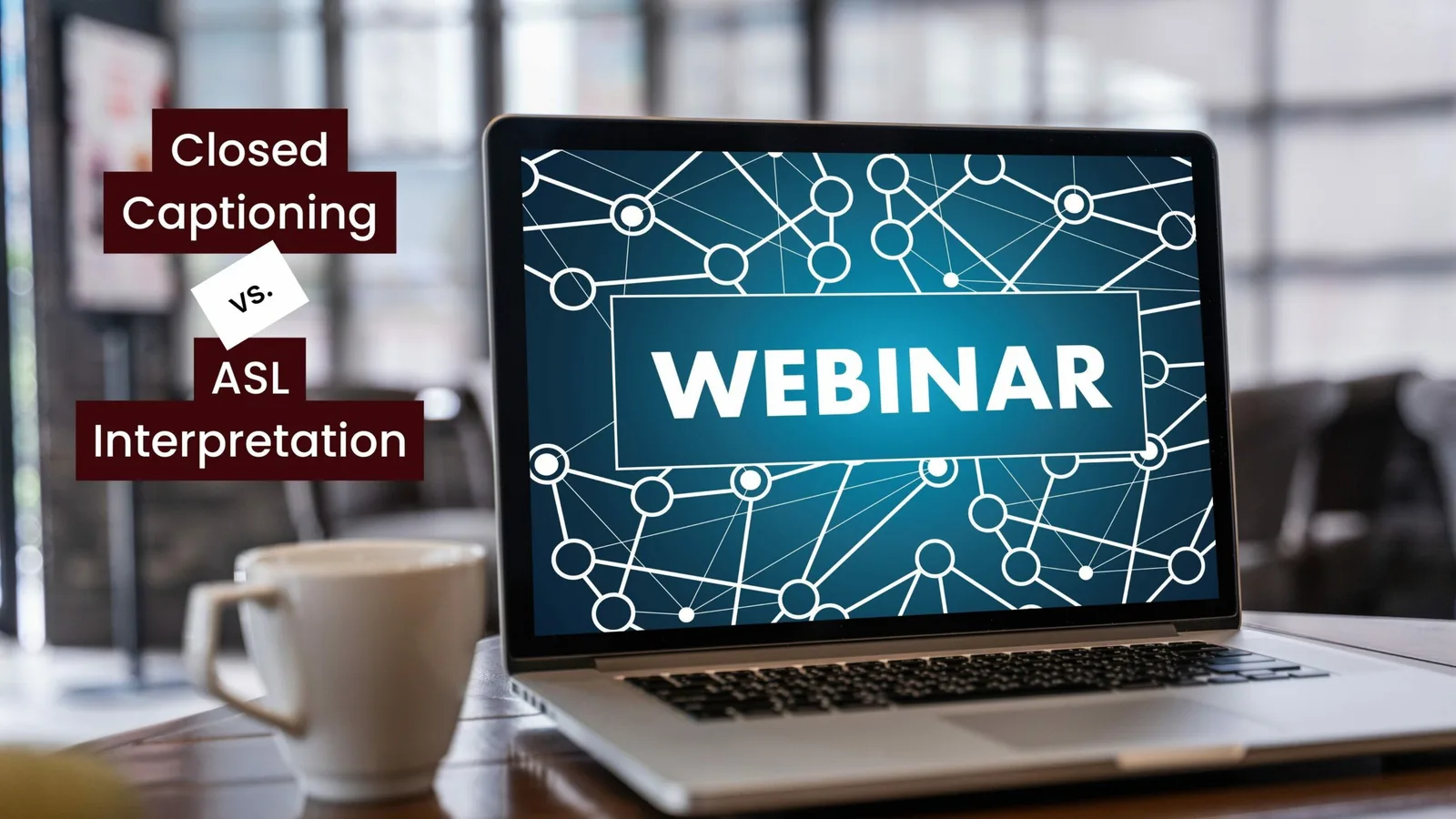
Many businesses leverage the strategy of hosting webinars to share valuable insights while promoting their services. According to the Content Marketing Institute, a whopping 58% of marketers utilize webinars to expand their businesses, with around 32% deeming webinar marketing critical for success in the current year. However, a significant number of webinars unintentionally neglect the needs of diverse viewers, inadvertently excluding crucial demographics from their potential audience.
Crafting marketing content that is accessible to all can significantly enhance your reach, generate leads, and boost sales. This inclusivity extends to creating content tailored for Deaf and hard-of-hearing audiences. In the United States alone, there are over 1 million individuals who are deaf and more than 10 million who are hard of hearing. This article aims to provide valuable insights into how your business can organize inclusive webinars and broaden its audience reach.
Do you offer closed captioning or multilingual subtitles for your webinar? Make sure to prominently showcase the accessibility features your business will provide. Avoid burdening your viewers with the task of hunting down this information. By openly sharing these details, you demonstrate your brand's commitment to inclusivity but also expand your registration list.
If you're uncertain about the specific accommodations your business should prepare for your webinar, consider incorporating a section where your audience can request accommodations directly on the registration form. It's advisable to encourage your audience to request accommodations at least two weeks before the webinar date, ensuring ample time for preparation.
While captioning serves as an excellent starting point to ensure your webinar is accessible to a broader audience, it's vital to understand that accessibility is not one-size-fits-all. Additional accommodations, such as sign language interpretation, may be necessary to genuinely cater to diverse audiences.
The Deaf Community encompasses a spectrum of individuals, including those who identify as Deaf, deaf, hard-of-hearing, and DeafBlind. Each subgroup within this community possesses unique accessibility needs and communication preferences. To genuinely promote inclusivity, it is imperative to adapt your approaches accordingly.
American Sign Language (ASL) is a language entirely distinct from the English language. Many individuals within the Deaf Community are born deaf and consider ASL their primary language, with English serving as their secondary language. Requesting sign language interpretation as an accommodation provides true equal access to webinars and events in the Deaf attendees’ native language.
For members of Deaf audiences, providing only captioning can essentially be likened to translating content into an entirely different language as they read. Transcribing spoken words doesn't capture the same depth of meaning or nuances for those who communicate primarily through ASL. This concept can be likened to a native Spanish speaker who, although possessing some proficiency in English, would greatly prefer participating in Spanish-language events.
By providing ASL interpretation alongside captioning, your business can bridge the communication gap and ensure that all members of the Deaf Community can engage with your webinars and content. Offering full accessibility in your webinars signals to all audience members that your brand values genuine inclusivity.

Shelby Edwards
Trouble with the form? Open it in a new tab.
Tell us what you’re planning and a coordinator will come back with options and pricing.
A practical comparison for event planners, coordinators, and access leads weighing Video Remote Interpreting against sending an interpreter in person.
July 10, 2026 · 3 min read
I went to a popular historical museum in North Carolina with my mother to celebrate our spring birthdays. We joined the line, sent our backpacks through security, and walked over to pick up the audio…
May 8, 2026 · 6 min read
Four years after The Expanded Language Access Law was adopted in New York, state representatives are now opening discussions around the official inclusion of American Sign Language (ASL). This blog lo…
April 18, 2026 · 4 min read